 Start a project
Mapped offer · Chosen
A live, monetised SaaS, built and run by one person, from empty repo to launch in 3 weeks
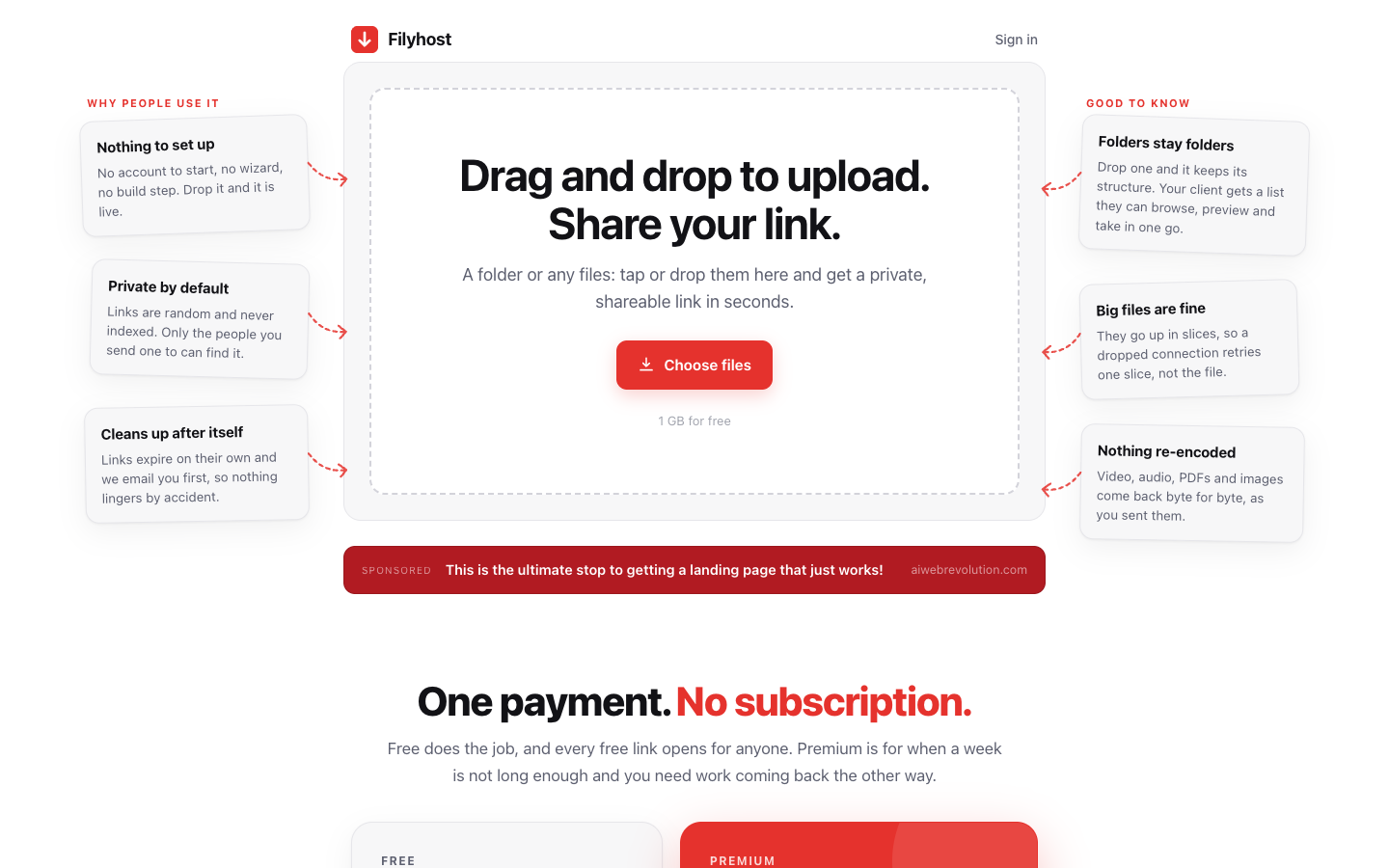
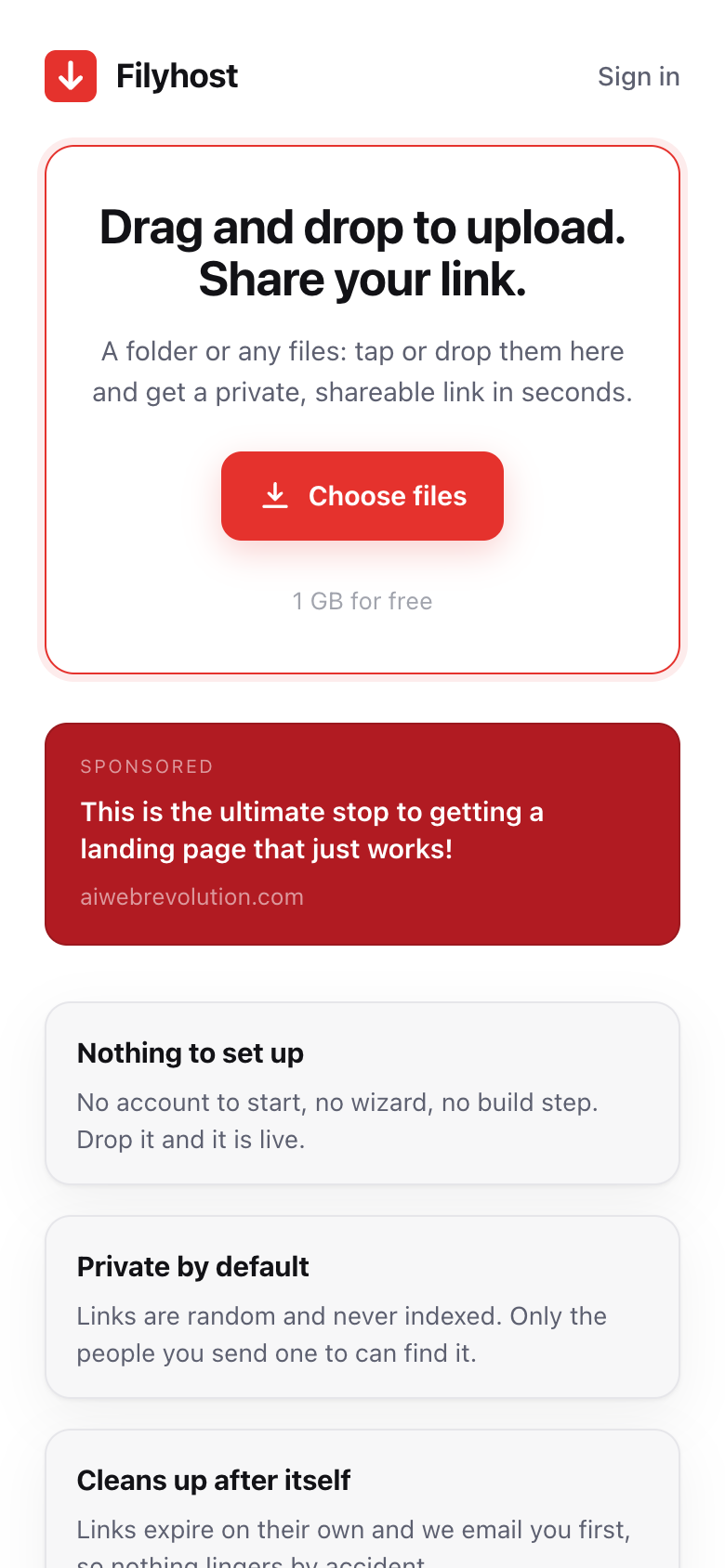
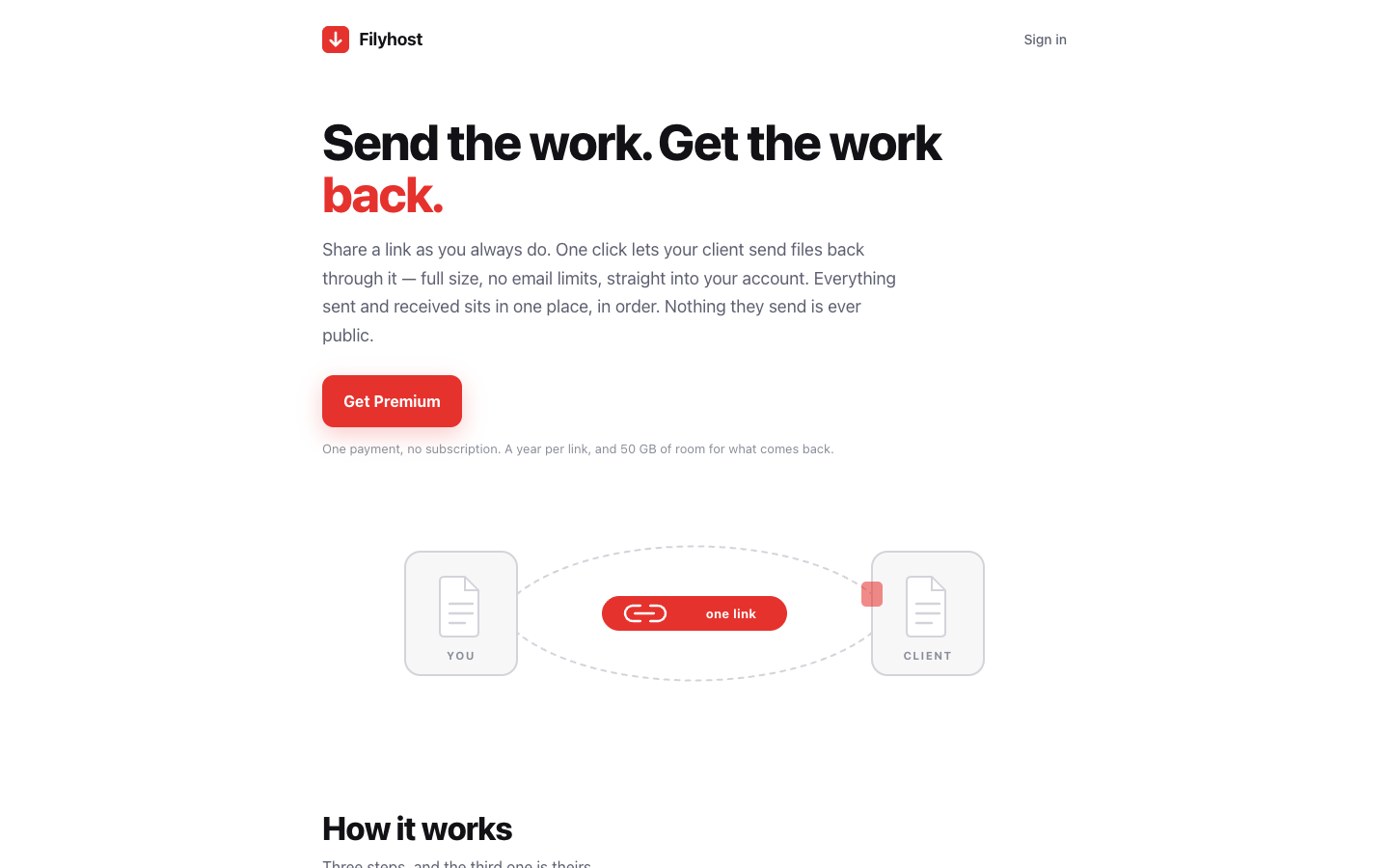
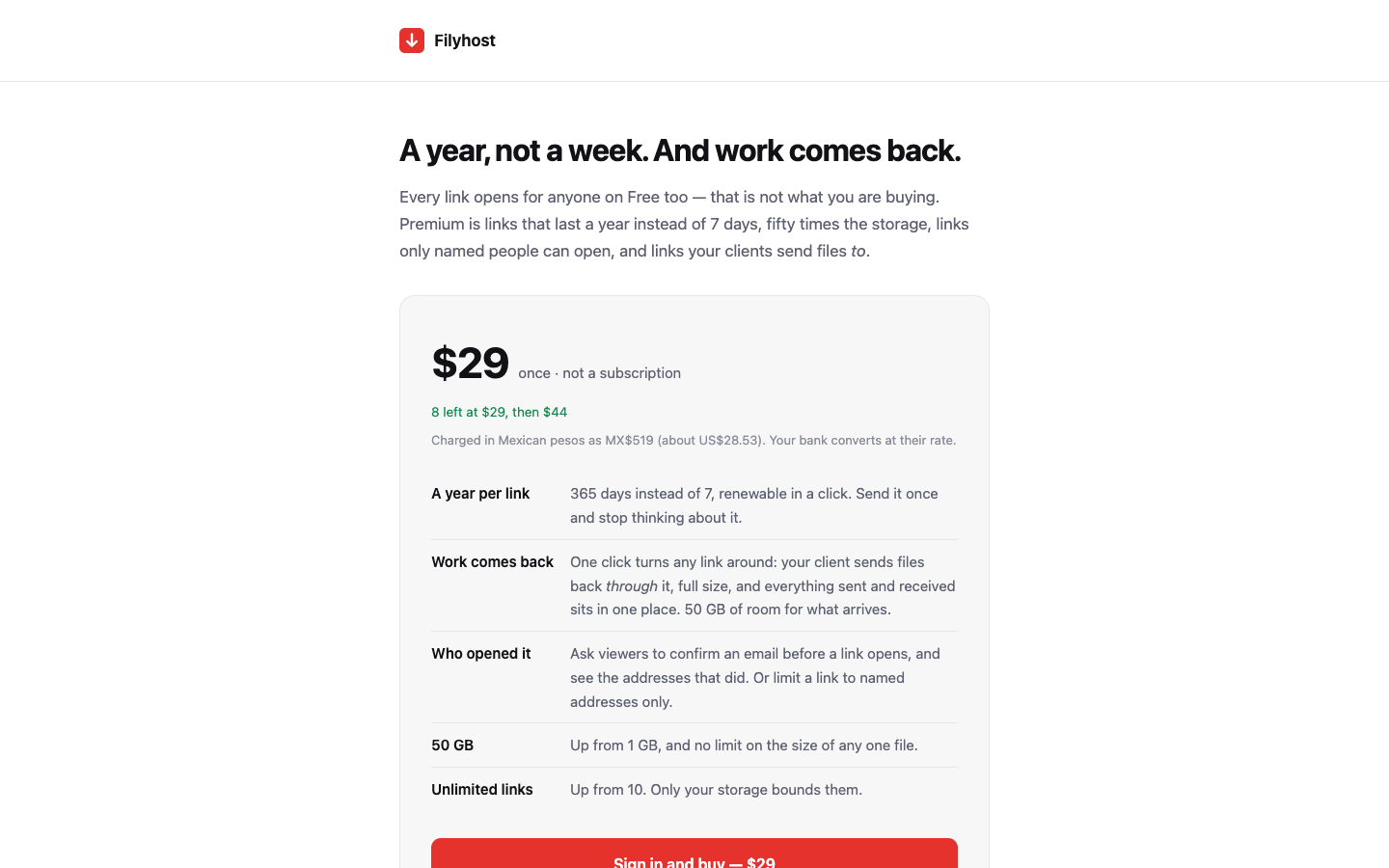
Filyhost hands files to clients and gets files back: one private link out, one inbox link back, and no account for the client. It runs on Cloudflare’s edge, so the bill grows with stored gigabytes, not with visitors. Licences sell through Stripe on a rising price ladder, and a self-serve ad slot is open to advertisers.
Live at filyhost.com · built 31 Aug–21 Sep 2026 · 173 commits · numbers observed 2026-10-05
Open the live product: filyhost.com01 · Before
Sending work is easy. Getting files back isn’t. The problem, as agencies live it.
Every agency knows the routine. Big files go through a transfer service, folders through a cloud drive, the rest by email. Then you chase the client for their logo, their copy, their photos, and the paid tools that would fix it put a sign-in wall in front of the very person you need files from.
- sending
- risk: One tool for big files, another for folders, email for the rest
- receiving
- problem: Chasing the client by email until something arrives
- client
- problem: Paid tools ask your client to create an account first
- pricing
- risk: Per-seat subscriptions for something you use twice a month
- lifespan
- risk: Links that live forever unless someone remembers to delete them
02 · What I built
One link out, one link back Gold is a person acting. Teal is the edge at work.
The whole product is a single Worker in plain JavaScript, with no framework and no build step. The browser does the heavy lifting on the way in, and the edge streams on the way out, so neither a huge upload nor a 50 GB download ever needs a big server.
- Step 1 (you): Drop a folder, browser unzips & slices. Rejected here: Over budget (sign-ups pause first).
- Step 2 (automated): Multipart upload, parts checked on arrival.
- Step 3 (automated): Private link, expires on its own. Rejected here: Abuse report (kill switch, link gone).
- Step 4 (client): Client opens, no account.
- Step 5 (client): Sends files back, inbox link.
- Step 6 (automated): Email on arrival, to you.
- Step 7 (live): Resumable download, any byte, any size.
03 · Who did what
Who did what Agents propose. A human approves.
-
agent://researcher
Mapped how agencies hand work over today and where each tool forces an account or a subscription.
Never allowed to: choose the positioning.
-
human://vegardHUMAN GATE
Chose the product: one link out, one link back, a one-time licence instead of a subscription.
-
agent://architect
Drafted the storage model and a separate content domain, so an uploaded HTML file can never touch the app’s login.
-
agent://builder
Wrote the Worker, the browser-side slicer, the streaming download and the Stripe price ladder to spec.
-
agent://tester
Drove a real local server through upload, expiry and purge end to end, and caught a cron bug on its first run.
-
human://vegardHUMAN GATE
Measured the passkey library at 48% of the bundle and cut it. Evidence over features.
-
agent://watcher
Guards spend, runs 8 rate limiters and sends a daily ops email.
Never allowed to: let the bill run away: new sign-ups pause first, then new uploads.
-
human://vegardHUMAN GATE
Ships every release from a clean, pushed commit. The deploy script refuses anything else.
04 · Results
Results, with receipts Every number dated, with its method.
| Number | What it measures | How it was measured | Observed |
|---|---|---|---|
| 3 weeks✓ verified | from empty repo to live, monetised SaaS | git history 31 Aug–21 Sep 2026 | 2026-10-05 |
| 173✓ verified | commits | git history | 2026-10-05 |
| ~0.1 s✓ verified | of CPU to stream a 50 GB inbox download as TAR (vs ~91 s with ZIP's CRC-32) | edge benchmark | 2026-10-05 |
| 3 GB✓ verified | resumable download verified on the edge (built for 50 GB) | edge test | 2026-10-05 |
| 8✓ verified | edge rate limiters | wrangler config | 2026-10-05 |
| 8,695✓ verified | disposable-email domains blocked, list refreshed weekly | blocklist size | 2026-10-05 |
| $29 → $119✓ verified | lifetime licence price ladder | pricing config | 2026-10-05 |
| Not published | Revenue and customer count | own product; revenue figures stay private | — |
05 · Running costs
What it costs to run Storage, not traffic.
There is no server to keep warm. Files sit in object storage and are streamed from the edge, and streaming a 50 GB folder as a TAR archive takes ~0.1 s of CPU. So the bill follows stored gigabytes, not visitors. A budget guard watches spend: at the limit it pauses new sign-ups, and if spend keeps rising it pauses new uploads, while every existing link keeps working.
- CPU for a 50 GB downloadstream a 50 GB inbox download as TAR (vs ~91 s with ZIP's CRC-32)
- ~0.1 s
- Edge rate limitersabuse and cost protection, before any code runs
- 8
- Disposable-email domains blockedrefreshed weekly, so free accounts stay real
- 8,695
06 · Ownership
What you would own If I built a portal like this for you.
- The repositoryEvery line, with the release history: each live version is a pushed, diffable commit.
- Your Cloudflare accountWorkers, object storage, database, rate limiters and cron, in your name.
- Your Stripe accountPrices, the ladder logic and payouts go straight to you.
- A separate content domainSo files your users upload can never reach your app’s login.
- Ops email and runbookA daily report, the budget guard settings and the abuse kill switch, documented.
- The lifecycle testsUpload, expiry and purge, driven end to end against a real server.
07 · What I’d build for you
A client portal or paid tool that runs itself, on your accounts
Client portals, file intake, quote tools, member areas: if your business sends things to clients or needs things back, I’ll build the portal with the same discipline. Payments, abuse handling and cost guards are part of the build, not phase two.
- Portal or tool on your domain, your Cloudflare and your Stripe
- No client accounts unless you want them; one-time codes instead of passwords
- Budget guard and rate limits from day one
- Optional MCP endpoint so your clients’ AI agents can use it
Not for you if an off-the-shelf tool already does the job. I’ll tell you so on the first call.
08 · Under the hood The technical depth, for your CTO
- Runtime
- Cloudflare Workers in vanilla JavaScript, no framework, no build step: ~20,000 lines of source. R2 for files, D1 for accounts and links, the Cache API, three cron triggers.
- Uploads
- Zips are unpacked in the browser with
DecompressionStream, never held in memory whole. Files are sliced and uploaded as multipart parts, each validated on arrival, so a bad upload fails fast instead of at 100%. - Downloads
- A streaming USTAR archive instead of ZIP: a 50 GB inbox costs ~0.1 s of CPU to stream, where ZIP’s CRC-32 would burn about 91 s. Downloads resume at any byte offset with zero stored state (fixed-length stream plus ETag and If-Range). Verified at 3 GB on the edge.
- Isolation
- User content is served from a separate registrable domain, so uploaded HTML can never touch the app’s auth scope.
- Abuse and limits
- 8 rate limiters, Turnstile, a weekly-refreshed blocklist of 8,695 disposable-email domains, and a kill switch that takes a reported link down in place.
- Viral links
- A link that goes viral costs one database read per data centre per minute, memoised in the Cache API, not one per request.
- Payments
- Stripe, with a lifetime licence that climbs $29 → $119 as live sales accumulate. Ads in the sponsored slot are bot-filtered and rotated by weight, rendered server-side with no layout shift.
- Trade-offs
- Passkeys were removed after measuring: one passkey library made up 48% of the Worker bundle (773 KiB). Evidence decided, not taste.
- Launch film
- The product film was rendered frame by frame from HTML, in 16:9 and 9:16, with a timed voiceover script.
More work Same rules: numbers dated, names changed where a client asked.
All case studies →
OWN PRODUCT · LIVE ↗
Crawler compute 103 → 0
SitShape: a sofa-shape configurator and seller marketplace
564 pre-rendered pages in 3 languages, 559 automated tests, sellers who never pay commission.
- Configurator
- Marketplace
- Static edge
OWN PRODUCT · LIVE ↗
15 countries, every US state, 26 cantons
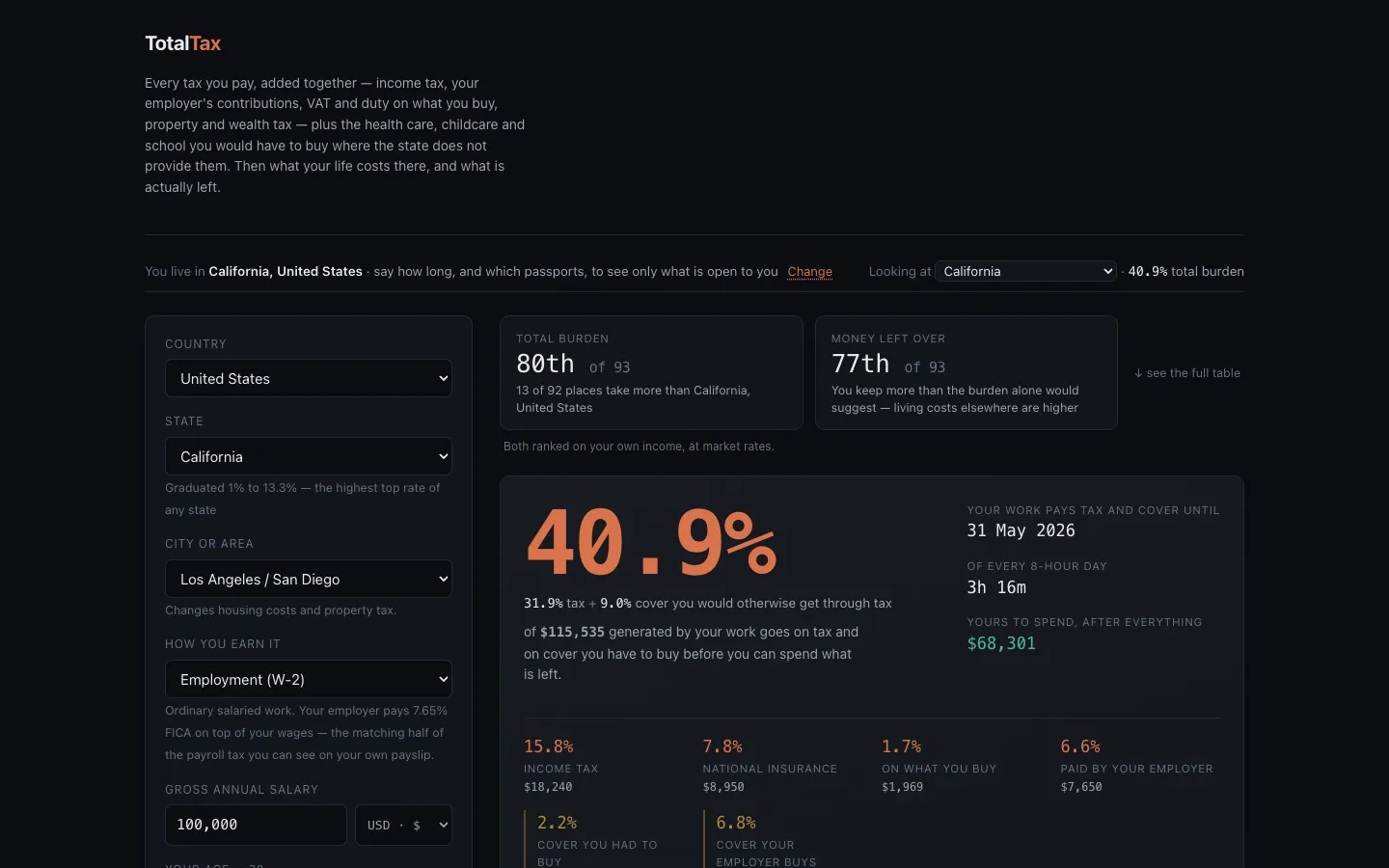
TotalTax: a sourced tax engine for 15 countries
The build fails if any figure lacks a dated source. ~1,100 automated tests. It runs in the browser by design, so nothing leaves it: the proof here is the engine, not AI visibility.
- Calculator
- Rules engine
- Lead magnet
OWN PRODUCT · PILOT
Core built in ~2 days
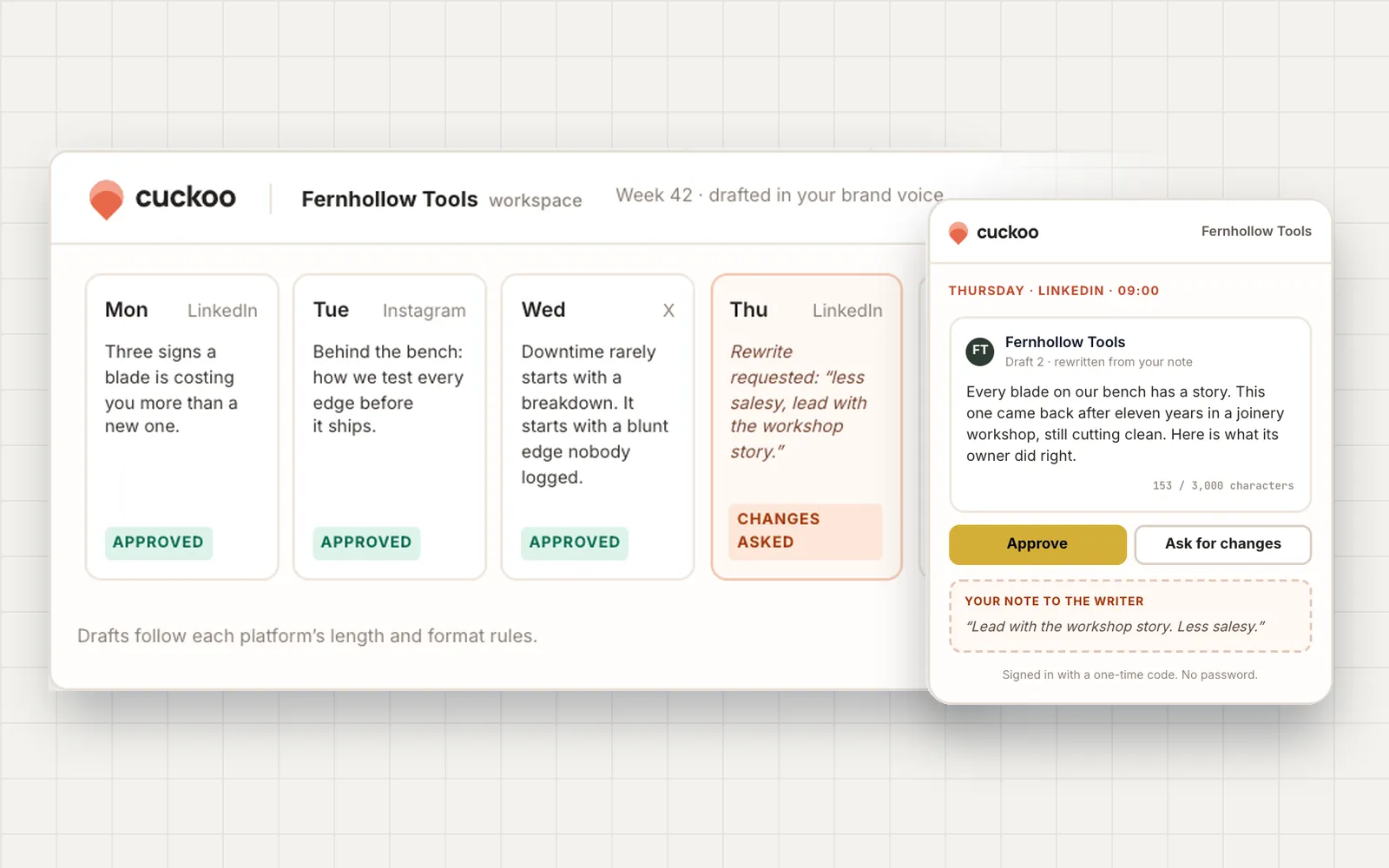
Cuckoo: a week of posts, approved from a phone
4 AI providers draft a week per channel; the client approves on the phone. Platform approvals pending.
- Distribution engine
- Approval portal
This case maps to Custom AI Tools, Portals & Agent Endpoints. The thinking behind builds like this: field notes in Insights.